
Maruti Suzuki India's shares gained over 2.5 per cent after a strong March-quarter performance, with analysts maintaining a positive medium-term outlook driven by buoyant domestic market volumes, capacity expansion, and export growth, despite anticipated near-term margin pressures from higher commodity prices and startup costs.

Of course, NOT! Here's why. And here's how you can increase your Rs 1 crore retirement corpus.
Brokerage firm Jefferies maintains a 'Buy' rating for Paytm, citing its dominant merchant payments platform and projected revenue growth.
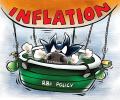
The Reserve Bank of India has increased its retail inflation projection for 2026-27 to 5.1 per cent, up from an earlier estimate of 4.6 per cent. This revision is primarily attributed to mounting input costs, driven by the pass-through of higher global energy prices to domestic petrol and diesel rates, which have seen significant increases since May.

Foreign Portfolio Investors (FPIs) have withdrawn Rs 14,231 crore from Indian equities so far in May, extending the total outflow for 2026 to over Rs 2 lakh crore, driven by persistent global macroeconomic uncertainties including inflation, interest rates, and geopolitical risks.

India's gross savings rate is projected to be nearly 47 basis points higher in FY25 than previously estimated, following the Securities and Exchange Board of India's (Sebi) revision of the methodology for calculating household savings routed through the securities market.

Sun Pharmaceutical Industries' acquisition of US-based Organon & Co. for $11.75 billion, the largest overseas acquisition by an Indian pharma company, has been met with mixed reactions from brokerages, who see strategic entry into women's health and biosimilars but also flag potential integration challenges and debt concerns.

From the Sensex firms, State Bank of India, Bajaj Finserv, Bajaj Finance, Maruti, HCL Tech, Larsen & Toubro, Mahindra & Mahindra and Infosys were among the major winners. However, Hindustan Unilever, Eternal, Tata Motors Passenger Vehicles, and Sun Pharma were among the laggards.

Jewellery majors Titan Company and Kalyan Jewellers reported robust Q4 FY26 results, with Titan's consolidated revenue surging 81 per cent year-on-year, largely propelled by a sixfold increase in bullion and digital gold sales. Despite strong top-line growth, Titan's gross and operating profit margins faced pressure due to the higher share of lower-margin gold products and increased marketing expenditure.

TVS Motor Company is strategically positioned for sustained outperformance in the domestic two-wheeler industry, propelled by increasing market share in scooters, premium motorcycles, electric vehicles (EVs), and robust export growth, according to analysts.

Dabur India's shares rose 3.7 per cent after reporting in-line Q4FY26 results, driven by a healthy 10 per cent growth in its India business, despite some analysts remaining cautious about future execution.

Indian companies are increasingly turning to share buybacks as a preferred payout strategy, driven by recent tax framework changes that make them more tax-efficient for non-promoter shareholders and a fall in stock prices.

'Even last year, when India bought gold, the physical quantity was much less than the previous years.'

The Bank Nifty is currently trading at a 43.5 per cent discount to the Nifty 50, near its widest gap since 2015, reflecting investor pessimism despite the banking sector's strong earnings growth.

Mumbai Police's 1930 cyber helpline has successfully intercepted and frozen over 101 crore defrauded from citizens in the last five months, preventing significant financial losses.

Shares of Avenue Supermarts, operator of DMart, fell 5.2 per cent after reporting mixed Q4 FY26 results, with brokerages offering divergent 'sell', 'buy', and 'hold' ratings based on factors like valuation, competitive intensity, and store expansion strategies.

"Taxpayers with income from shares, mutual funds, crypto, ESOPs, or derivatives often incorrectly use ITR-1 instead of ITR-2 or ITR-3."

The diagnostics sector is projected to significantly outperform other healthcare segments like pharmaceuticals and hospitals in Q4FY26, driven by increasing volumes, stable realisations, and a domestic focus that insulates it from geopolitical risks.

Godrej Properties closed FY26 with record bookings and presales, exceeding its annual guidance, but brokerages express concerns over weak cash-flow generation and the ability to sustain growth amidst a muted real estate market.

Stock markets closed higher on Friday after the Reserve Bank of India kept its benchmark interest rate unchanged as expected and proposed allowing banks to lend to Real Estate Investment Trusts (REITs) with certain prudential safeguards to deepen the financing pool for the real estate sector.

Hindustan Unilever (HUL) exceeded consensus estimates in Q4FY26, driven by lower overheads and 6 per cent consolidated volume growth. However, the company anticipates further price hikes to counter an expected 8-10 per cent material cost inflation, while maintaining a mid-term margin guidance of 22.5-23.5 per cent.

'OMCs are incurring losses of Rs 1,000 crore per day due to the West Asia crisis.'

Despite geopolitical tensions and FII outflows, Indian small and midcap stocks have not only recovered losses but are also outperforming largecap indices, driven by attractive valuations, domestic institutional support, and a rebound in earnings.

India's manufacturing sector experienced a mild recovery in April, with the HSBC India Manufacturing Purchasing Managers' Index (PMI) rising to 54.7 from 53.9 in March. However, inflationary pressures intensified, with input costs increasing at the fastest pace since August 2022, largely attributed to the Middle East conflict.

Investors have often been left scratching their heads over why a company's stock fails to move despite delivering beating earnings results, only to see the stock fall. According to theory, beating earnings should translate to higher stock prices, but in today's interconnected world, stock prices do not depend on the numbers.

Indian equity benchmarks Sensex and Nifty surged nearly 1 per cent, driven by strong earnings reports from FMCG and auto sectors, alongside a rally in Asian markets and signs of de-escalation in geopolitical tensions.

Macroeconomic data, global geopolitical developments and rising concerns over AI-related disruptions are likely to dictate sentiment in the stock market next week, even as investors may remain cautious amid ongoing volatility, according to analysts.

India has no plans to ration fuel supplies despite ongoing disruptions in global energy markets, according to a top oil ministry official. The country has maintained adequate inventories of crude products and LPG while diversifying imports to manage supply risks.

Suryakumar Yadav's future as India's T20 captain is uncertain, with his place in the team as a batter under scrutiny. Gautam Gambhir's support as head coach could be decisive, despite concerns from the selection committee about Suryakumar's recent form and suitability for the 2028 Olympics.

Info Edge (India) shares fell 2.9 per cent after the company reported muted growth in recruitment billings for Q4 FY26, leading brokerages to expect impacted operating performance and potential margin contraction.

Equity benchmark indices Sensex and Nifty rebounded sharply by nearly 1 per cent on Monday, driven by strong buying in power, banking, and financial stocks.

Stocks of fast-moving consumer goods companies have taken it on the chin in calendar year 2026 (CY26) with the Nifty FMCG index falling over 6 per cent compared to the Nifty 50 dipping 0.8 per cent. Nifty FMCG is one of the worst-performing sectors on the NSE in CY26.

'We are targeting a 2.5x to 3x increase in valuation by FY31.'

A section of industry may need to begin compliance immediately, even as most states are yet to notify their rules.

With duties at 15%, GST at 3%, and making charges running as high as 20% -- the gap between a smart purchase and a careless one can easily be Rs 30,000 to Rs 50,000 on every Rs 1 lakh invested. And most of that gap is entirely avoidable. Ramalingam Kalirajan explains the math.

India's fertiliser subsidy bill for the current financial year (FY27) is projected to increase by approximately 20% due to surging global prices, primarily driven by the West Asia crisis, a senior official confirmed. Despite this, retail prices for urea and di-ammonium phosphate (DAP) will remain unchanged, ensuring adequate supply for the kharif season.

'First-time applicants may witness longer approval times or higher rejection rates and requests for more documentation.'

Analysts have sharply reduced cigarette maker ITC's earning estimates for the next two years, fearing a significant dent in the company's profitability and margins. This is owing to a steep hike in excise duty on tobacco by the government.

Infosys shares experienced a significant drop, hitting a 52-week low, after the company announced its Q4FY26 results and provided a modest revenue growth guidance of 1.5-3.5 per cent in constant currency for FY27, falling below market expectations and raising concerns about AI-led deflation and margin pressures.

The government has dismissed speculation of an imminent increase in petrol and diesel prices, assuring citizens that there are no plans for a hike despite rising crude oil costs.
